IDEAS, WITHOUT THE SHORTCUTS
What is democratic socialism?
Start with who has a voice in economic decisions, then ask how that voice is protected.
3 free examples · No sign-up
Updated · Teste12Axes editorial project
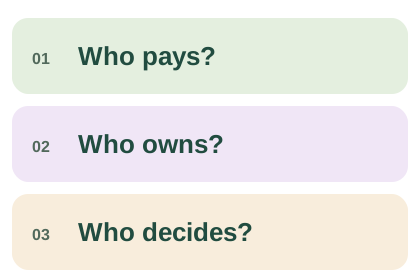
Democratic socialism seeks democratic control of economic life. These 3 questions make that goal concrete. To understand what is democratic socialism in a particular proposal, separate the questions: who pays, who owns and who can replace decision-makers. Organizations disagree about institutions; their own platforms are evidence about them, not universal definitions. Democratic Socialists of America
What is democratic socialism beyond public funding?
The Stanford account distinguishes social power from state power; state control alone does not establish democratic control. Treat that as a conceptual distinction, not a verdict on a contemporary country. Stanford Encyclopedia of Philosophy
Compare the terms
| Do not combine these questions | Ask instead |
|---|---|
| Who pays? | Taxes, fees, contributions or another arrangement? |
| Who owns? | Investors, workers, the public or a mixture? |
| Who decides? | Who selects, challenges and replaces decision-makers? |
| What protects disagreement? | Can affected people organize, object and seek a remedy? |
Swipe this table sideways on a phone; keyboard users can focus it and use the arrow keys.
A practical reading method: payer, owner, voice
Imagine a proposed water service. You could agree with its funding plan while disagreeing about who appoints the board. Or you could like elected directors but question whether residents can challenge a harmful decision. These are distinct judgments.
Write down the three roles separately. A proposal that changes only the payer has not, by that fact, answered an ownership question. A change of owner has not, by that fact, supplied a way to remove managers. The cases below hold the service constant so that you can inspect what changes.
Where social democracy enters the conversation
Ask whether a speaker proposes a particular reform within existing ownership, or a wider change to ownership and control. Shared support for a public benefit is not enough to settle that distinction. Look for the speaker’s stated goal and institutional proposal.
You do not need to settle a century of terminology before asking this useful follow-up: if the reform succeeds, who will have a decision-making right that they do not have now? If the text never says, record the gap rather than guessing its ideology.
Follow the same water service through three arrangements
Choose a situation, then open the explanation. These are fictional cases, not a test of your beliefs.
Preparing the case controls…
FICTIONAL CASE 01
Public funding, private appointments
An imaginary city pays a private water supplier so residents pay less. The original investors still appoint directors. The contract has no new resident or worker voting rights.
- Payer
- The city budget
- Owner
- Private investors
- New decision right
- None specified
What changed, and what has not been established?
What can we actually conclude?
Funding changed. No change in ownership or democratic control has been specified. This could be a concrete affordability proposal without telling us its author’s long-term economic goal. Ask for the contract, accountability rules and goal before adding a system label.
FICTIONAL CASE 02
City ownership, one appointed director
The city now owns the same fictional supplier. A single appointed director sets all internal rules. The example does not say whether workers or residents can challenge the director or vote them out.
- Payer
- The city budget
- Owner
- The municipality
- Accountability
- Not specified
Does public ownership answer the democracy question?
What can we actually conclude?
No. The owner changed, while the accountability question remains open. Ask who can replace the director, how service users can contest a decision and what rights workers retain. Do not treat an unanswered question as evidence that participation either exists or is impossible.
FICTIONAL CASE 03
Residents and workers select a board
In a third imagined arrangement, workers and residents elect a joint board. Meeting records are public and there is an appeal route. The example still leaves prices, investment and wider economic ownership unspecified.
- Decision rule
- An elected joint board
- Challenge route
- An appeal process
- Still unknown
- Financing and wider arrangements
Have we now classified the entire economy?
What can we actually conclude?
No. We have added specific participation and challenge mechanisms to one service. That makes the democracy question more concrete, while leaving affordability, investment and other institutions to examine. A useful explanation names both what the example shows and what it cannot show.
Situation 1 of 3
The controls only change what is displayed on this page. No answers are requested, saved, put in a URL or sent to Analytics. Changing language or reloading resets the examples.
Connect the idea to your profile without forcing a label
Use our economy axis to revisit distribution questions, work to revisit bargaining and workplace rules, and participation to revisit how people make public decisions. None of these alone measures collective ownership or verifies democratic institutions.
When a public-figure match surprises you, read the sourced comparison dimensions. A shared preference in four selected dimensions is not proof that you accept that figure’s full program. This explainer does not change the matching formula or add a political recommendation.
Questions worth asking
Does free health care make a society democratically socialist?
Financing one service is not enough evidence for a whole system. Ask about ownership and decision-making as well as who receives the service.
Is DSA the definition for every country?
No. It is one organization explaining its own position. Its self-description is useful primary evidence about that organization; it is not a neutral universal authority.
Can I get a democratic-socialism percentage here?
No. These examples explain institutions. Our quiz reports its own defined axes and an editorial match, without scientific validation or a certified ideology percentage.
What is democratic socialism compared with social democracy?
The names overlap in ordinary usage. A useful distinction asks whether the stated goal is reform within existing ownership or a wider transformation of ownership and control. Read the speaker’s own proposal rather than assigning a goal from one policy.
Does democratic socialism require every service to have one owner?
A label does not supply a complete institutional design. Ask which sectors the proposal addresses, which forms of ownership it specifies and how affected people gain control. This guide does not prescribe a universal ownership formula.
How can democratic socialism help me interpret a public-figure match?
It supplies questions to ask about a proposal. It does not validate a similarity percentage or prove that you share a person’s whole program. Read the dimensions and sources behind the match before drawing conclusions.
Sources & editorial choices
Definitions are concise summaries of the linked sources. The situations, comparison questions and reading method are our editorial examples, prepared with AI assistance. They are not survey findings or claims about any country. No independent political-science or native-language review is claimed.
- Democratic Socialists of America · What is Democratic Socialism? (self-description)
- Stanford Encyclopedia of Philosophy · Socialism
- Method and limits
Independent educational project. No affiliation with the organizations or authors cited. Corrections: support@teste12axes.com.
How this connects to the test
These examples explain concepts; they do not score your politics. The free test offers 36, 60 or 240 questions with no sign-up. Its PNG result card includes a Teste12Axes site-name watermark. Answers are processed in your browser; saving on this device is optional. The test costs $0; there is no paid tier.
An educational explanation, not voting advice, a diagnosis or a scientific classification of you.